Why Is My Cat Gulping and Swallowing Hard? Causes & When to Worry

Share
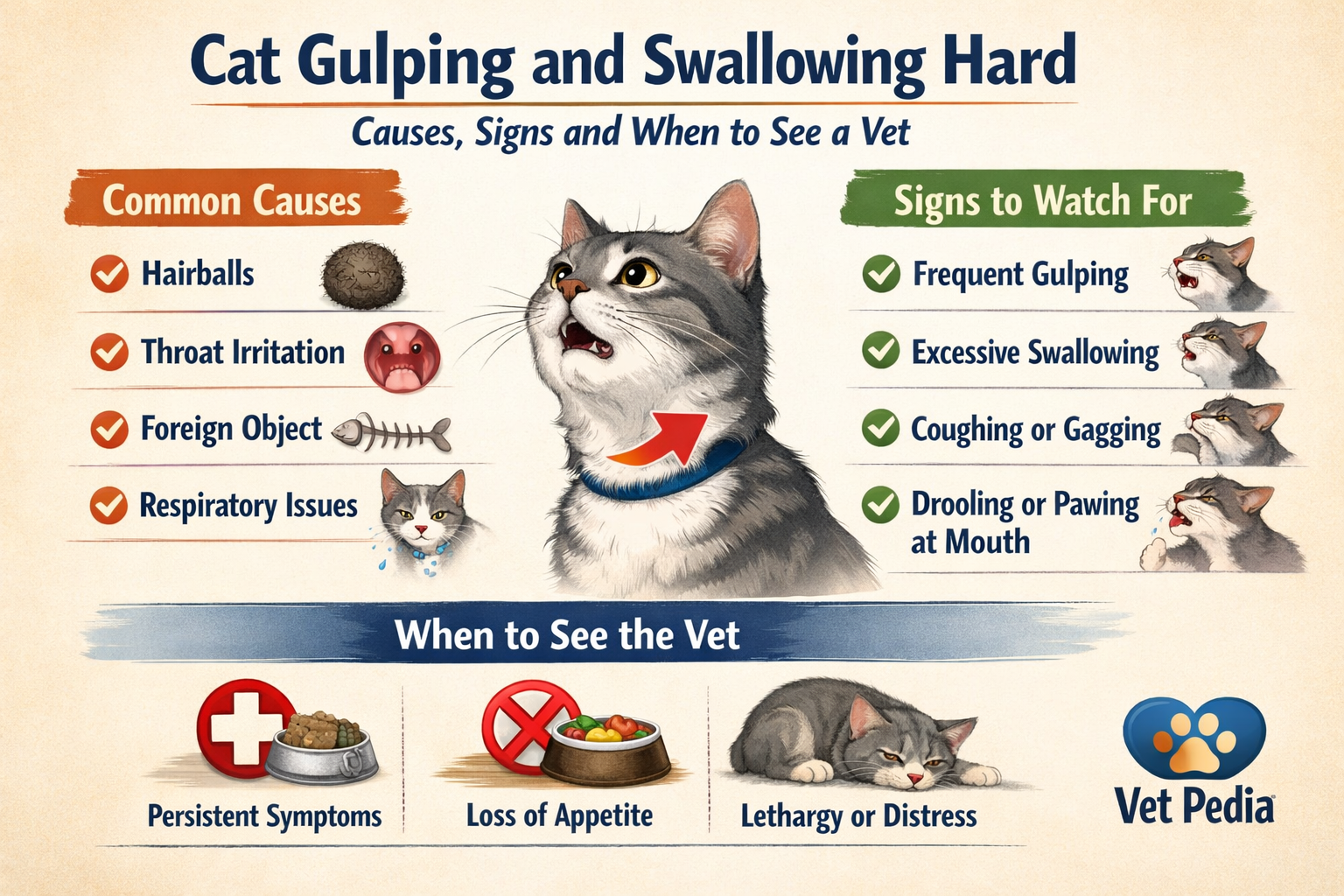
Cat gulping and swallowing hard — sometimes described by owners as repeated swallowing, lip licking, or a visible effort to move something down the throat — is a clinical sign that warrants attention. While an isolated episode after eating too fast is rarely cause for alarm, persistent or recurrent gulping in cats is frequently associated with conditions ranging from esophageal dysfunction and nausea to foreign body obstruction and respiratory disease. This article explains what causes cats to gulp and swallow hard, what to observe at home, and when to seek veterinary care.
What Does Cat Gulping and Swallowing Hard Look Like?
Owners often describe the behavior in different ways: repeated swallowing motions without food present, exaggerated throat movements, audible gulping sounds, or a cat that appears to be trying to clear something from its throat. Some cats accompany this with excessive lip licking — a reliable indicator of nausea in cats — or grass eating, which is a self-directed attempt to induce vomiting.
The behavior may occur before or after eating, at rest, or apparently at random. Duration and frequency matter: a cat that gulps once or twice after eating rapidly is very different from one that gulps repeatedly throughout the day, or that wakes at night gagging and swallowing.
Common Causes of Cat Gulping and Swallowing Hard
Nausea and Gastric Disease
Nausea is one of the most common reasons cats gulp and swallow repeatedly. Cats that also show skin reactions or hives alongside gulping may be experiencing a systemic allergic response. The behavior reflects activation of the swallowing reflex in response to hypersalivation and esophageal stimulation — both triggered by nausea. Underlying causes of chronic nausea in cats include inflammatory bowel disease (IBD), chronic gastritis, pancreatitis, and kidney disease (which causes uremic nausea). Cats with IBD frequently present with intermittent nausea, vomiting, and weight loss alongside episodic gulping.
Esophageal Disorders
The esophagus is a common site of pathology in cats that gulp and swallow hard. Key conditions include:
- Esophagitis — inflammation of the esophageal lining, often caused by acid reflux, prolonged anesthesia (gastric acid pooling during procedures), or ingestion of caustic substances. Cats with esophagitis frequently gulp, regurgitate, and may show pain when swallowing.
- Megaesophagus — abnormal dilation of the esophagus resulting in impaired motility. Affected cats regurgitate undigested food and often swallow repeatedly as food fails to pass normally into the stomach. Megaesophagus is less common in cats than dogs but does occur, particularly secondary to myasthenia gravis or other neuromuscular disease.
- Esophageal stricture — narrowing of the esophagus, most commonly following esophagitis or trauma, causes difficulty swallowing solid food with repeated gulping attempts.
Upper Respiratory and Nasopharyngeal Disease
Cats with post-nasal drip, nasopharyngeal polyps, or chronic upper respiratory infections frequently gulp and swallow to clear mucus or discharge draining into the pharynx. Nasopharyngeal polyps — benign inflammatory masses originating from the middle ear or Eustachian tube — are a particularly common cause of swallowing difficulty and repeated gulping in young cats. Affected cats may also show stertor (snoring-like breathing), nasal discharge, and head shaking.
Foreign Body Ingestion
Cats that have ingested a linear foreign body (thread, string, tinsel, rubber bands) or a solid object (bone fragment, plant material) may gulp repeatedly as they attempt to dislodge the object or as it causes esophageal or pharyngeal irritation. This is a potential emergency — linear foreign bodies in particular can cause intestinal perforation if not removed promptly.
Dental and Oral Pain
Painful oral conditions — including tooth resorption (a very common feline dental condition), stomatitis, gingivitis, or oral masses — can cause cats to swallow abnormally, drop food, or gulp as they attempt to eat while avoiding pain. Cats with severe stomatitis may hypersalivate and swallow constantly.
Hyperthyroidism
In middle-aged to older cats, hyperthyroidism can cause a range of gastrointestinal signs including vomiting, increased appetite, and occasionally dysphagia (difficulty swallowing) or gulping, thought to be related to thyroid gland enlargement pressing on adjacent pharyngeal structures, or increased GI motility.
Warning Signs: When Cat Gulping and Swallowing Hard Is an Emergency
Contact your veterinarian the same day, or go to an emergency clinic, if your cat shows any of the following alongside gulping and swallowing hard:
- Regurgitation of undigested food (distinct from vomiting — regurgitation is passive, with no abdominal effort)
- Repeated, unsuccessful attempts to vomit or swallow
- Drooling or hypersalivation that is new or worsening
- Visible distress, pawing at the mouth or throat
- Open-mouth breathing or labored respiration
- Progressive weight loss alongside gulping
- Suspected ingestion of string, thread, tinsel, or a solid object
- Pale, white, or bluish gums
- Sudden complete refusal to eat
Any cat that is gulping and swallowing hard persistently for more than 24–48 hours without an obvious benign cause (such as a single episode of eating too rapidly) should be evaluated by a veterinarian.
How Veterinarians Diagnose Cat Gulping and Swallowing Hard
Because cat gulping and swallowing hard is a non-specific sign with many possible causes, the diagnostic approach is systematic:
History and physical examination — your veterinarian will ask about symptom duration and frequency, diet, access to string or foreign objects, other clinical signs (vomiting, weight loss, sneezing, nasal discharge), and any recent anesthetic procedures. Oral examination under sedation may be needed to fully assess the pharynx, tonsils, and dental structures.
Blood and urine tests — a complete blood count (CBC), biochemistry panel, and urinalysis help assess organ function and screen for systemic disease including kidney disease, hyperthyroidism (T4 level), and pancreatitis (feline specific PLI).
Thoracic and cervical radiographs — chest X-rays are essential to evaluate the esophagus (looking for megaesophagus, foreign bodies, or mediastinal masses) and to rule out aspiration pneumonia, which can complicate esophageal disease.
Fluoroscopy or esophagography — a barium swallow study allows real-time assessment of esophageal motility and can identify strictures, diverticula, or motility disorders not visible on standard radiographs.
Endoscopy — upper gastrointestinal endoscopy allows direct visualization of the esophagus, stomach, and upper small intestine. It is the gold standard for diagnosing esophagitis, strictures, and gastric disease, and allows biopsy sampling for IBD or neoplasia.
Nasopharyngeal evaluation — if polyps or nasopharyngeal disease is suspected, retroflexed endoscopy or advanced imaging (CT) of the skull and nasal cavity may be recommended.
Treatment Options for Cat Gulping and Swallowing Hard
Treatment depends entirely on the underlying diagnosis:
- Esophagitis — managed with proton pump inhibitors (omeprazole, typically 1 mg/kg once daily in cats) to reduce acid reflux, sucralfate suspension to coat and protect the esophageal mucosa, and dietary modification (soft, warmed food; small frequent meals; elevated feeding position).
- Nausea and IBD — antiemetics such as maropitant (Cerenia) are highly effective for controlling nausea in cats. IBD is managed with dietary trials (hydrolyzed or novel protein diets), prednisolone, or chlorambucil in refractory cases.
- Nasopharyngeal polyps — surgical removal (traction avulsion or ventral bulla osteotomy) is curative in most cases. Recurrence is possible without bulla osteotomy.
- Foreign bodies — endoscopic or surgical removal depending on location and type. Linear foreign bodies anchored at the base of the tongue require urgent surgical intervention.
- Hyperthyroidism — treated with methimazole (transdermal or oral), radioactive iodine therapy (I-131, curative), or thyroidectomy. Resolution of hyperthyroidism typically resolves associated GI signs.
- Dental disease and stomatitis — dental extractions, professional cleaning, and pain management; full mouth extraction is often the most effective long-term treatment for severe feline stomatitis.
What to Monitor at Home After Cat Gulping and Swallowing Hard
If your cat is gulping and swallowing hard and you are waiting for a veterinary appointment, document the following:
- How many times per day the gulping occurs, and in what context (before eating, after eating, at rest, overnight)
- Whether it is accompanied by lip licking, grass eating, drooling, or vomiting
- Food intake — is your cat eating normally, eating less, or avoiding food entirely?
- Any access to string, thread, rubber bands, tinsel, or small objects that could have been swallowed
- Body weight — weigh your cat weekly if you have a scale; weight loss in cats can occur rapidly and is clinically significant
This information will help your veterinarian narrow the diagnosis efficiently and choose appropriate tests. Avoid giving over-the-counter antacids, human antiemetics, or any medications without veterinary guidance — many human medications are toxic to cats.
Frequently Asked Questions About Cat Gulping and Swallowing Hard
Why does my cat keep gulping and swallowing but not vomiting?
Repeated swallowing without vomiting often points to nausea (the body suppresses vomiting while the swallowing reflex fires repeatedly), esophageal irritation, or a pharyngeal issue such as a polyp or post-nasal drip. It is worth a veterinary evaluation if it persists beyond a day or two.
Is cat gulping always serious?
Not always — a single episode after eating too fast or grooming excessively is usually benign. Persistent or recurrent gulping, particularly if combined with other signs like weight loss, drooling, or regurgitation, requires investigation.
Can stress cause a cat to swallow hard?
Stress can trigger nausea, and nausea causes gulping and lip licking. However, stress should always be a diagnosis of exclusion — medical causes must be ruled out first before attributing swallowing behavior to anxiety.
My cat gulps at night — is that different?
Nocturnal gulping is often associated with acid reflux or esophagitis. Gastric acid production increases when a cat is lying down and fasting overnight, and reflux into the esophagus triggers the swallowing reflex. This pattern specifically warrants esophageal evaluation.
Could my cat have swallowed something?
If your cat had access to toxic foods or string, thread, tinsel, rubber bands, or small objects and is now gulping, pawing at its mouth, or refusing food, treat this as an emergency. Foreign body ingestion in cats can be life-threatening and requires immediate veterinary assessment.
Summary: Cat Gulping and Swallowing Hard
Cat gulping and swallowing hard is a clinical sign — not a diagnosis — that reflects a range of conditions from benign to serious. The most common causes are nausea (often due to IBD, kidney disease, or pancreatitis), esophageal disorders (esophagitis, megaesophagus, stricture), and nasopharyngeal disease (polyps, upper respiratory infections). Foreign body ingestion and dental disease are also important considerations. Persistent gulping warrants veterinary evaluation; a thorough history, physical examination, and targeted diagnostics (bloodwork, radiographs, endoscopy) are needed to identify the underlying cause and guide appropriate treatment. Early diagnosis leads to faster relief for your cat and prevents complications such as aspiration pneumonia or esophageal stricture formation.
For further reading on feline digestive health, the American Veterinary Medical Association (AVMA) and the Canadian Veterinary Medical Association (CVMA) offer comprehensive owner resources on recognizing and managing gastrointestinal conditions in cats.
Reviewed by the Vetpedia Veterinary Editorial Board. This article provides general clinical information and does not replace individualized veterinary advice. Always consult a licensed veterinarian for diagnosis and treatment of your pet.